First 3 Days on a Scooter in Phuket: Where to Practise Safely
Your first 3 days on a scooter in Phuket, day by day: quiet roads in Rawai, Mai Khao and Bang Tao, then town, then a hill, and when to book a lesson.
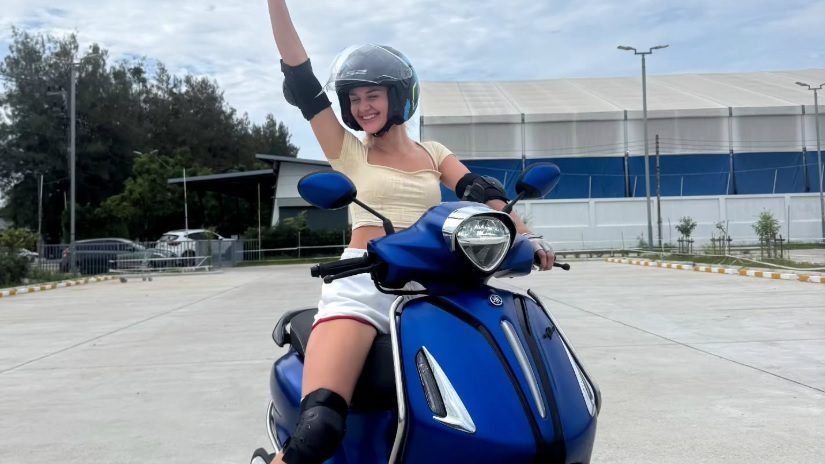
This is not a guide on how to ride a scooter. It is a guide on where to ride one during your first three days in Phuket, so that your learning curve happens on an empty road in Rawai and not on the Patong hill at dusk. Most tourist scooter crashes are not about skill in the abstract; they are about the wrong road on the wrong day. If you can already balance, use both brakes and stop where you intend to, this plan tells you which districts to take that skill to, in which order, and when to stop and book a two-hour lesson with an instructor instead.
Before day one: the three checks
1. Your licence
In Thailand category A (motorbike) is mandatory for any scooter, including a 110–125 cc automatic. A car licence does not cover it, with or without an international permit. If you ride on a car licence only, a checkpoint costs 200–1,000 baht, but the real problem comes after a crash: insurers refuse payouts for "incorrect licence category", and that is the most common reason tourist claims are denied. If your home licence has category A, carry it together with a 1968-style International Driving Permit. If it does not, the school helps with a Thai licence: category A costs 11,000 baht and takes 5–7 working days. Details on the Thai driving licence for foreigners page. Keep the licence on you every ride: leaving it at the hotel is a fine of up to 1,000 baht.
2. Your rental
A Honda Click 125 or 150 rents for 150–300 baht a day (up to 350 for a brand-new bike); monthly rates run 2,000–6,000 baht depending on season and bike age. Deposit is 1,000–2,000 baht or a passport copy. Never leave your original passport as a deposit. Before you ride away, photograph every scratch on the bike with the shop owner watching.
3. Your helmet
No helmet is a fine of up to 2,000 baht and a point on your record; a passenger without one doubles it, up to 4,000 baht in total. Since 1 June 2025 police issue the maximum nationwide. Ask the shop for a helmet that actually closes under your chin, not one that sits on top of your head.
The check before every ride
Thirty seconds, every time, for all three days:
- Squeeze both brake levers: firm, not spongy, and the bike stops when you roll it.
- Tyres: pressed with a thumb, they should barely give.
- Lights and both mirrors. Adjust the mirrors sitting on the bike, not standing next to it.
- Fuel above a quarter. Running dry on a hill is how people learn to push.
- Helmet strap closed, licence and rental papers in your pocket.
- Sky: if it is about to rain, wait. The first ten minutes of Phuket rain are the slipperiest.
Day 1: flat, quiet, empty
Day one has one goal: ride for two or three hours without meeting traffic that can hurt you. Go out at 07:00, when the roads are coolest and emptiest, and be done before lunch. Ride alone, no passenger. Three districts work well, and you only need the one nearest your hotel.
Rawai and Nai Harn back roads
Behind the Rawai seafront and around Nai Harn the side roads are flat, wide enough and mostly used by locals going to the market. Find an empty parking area first and spend thirty minutes on figure eights, slow U-turns with the bars at full lock, and emergency stops with both brakes from 20, then 30 km/h. Then ride the back roads in loops, keeping to the far left, practising smooth throttle and mirror checks. Avoid the main road towards Chalong on day one.
Mai Khao straight roads
In the north, the long straight roads around Mai Khao are the easiest place on the island to get used to a scooter's speed and braking. Little traffic, long sightlines, nothing to turn around. Ride out, stop, turn in a pocket, ride back. Practise braking from a steady 40 km/h to a full stop at a chosen mark until it feels boring.
Bang Tao lanes
Bang Tao has a grid of small lanes between the beach and the main road where speeds are low and corners are frequent. It is the place to practise slow turns, stopping at side-road junctions, and looking right first in left-hand traffic. Stay off the main Bang Tao road until day two.
How to know day one went well: you stopped exactly where you wanted to every time, your right hand stopped jerking the throttle, and you never once grabbed only the front brake in a hurry. If any of these is not true, do not move on. Repeat day one, or take a lesson (see below).
🛵 Rent a scooter in Phuket
- ✓Book a scooter before you arrive
- ✓Compare several rental shops at once
- ✓No passport left as a deposit — check terms
Day 2: light town traffic, U-turn pockets, roundabouts
Day two adds other vehicles, but on your terms: mid-morning, after the school and work run, in areas where traffic moves slowly. Chalong, the edges of Phuket Town and Kathu are the usual choices. New things to practise:
- Lane position. Motorbikes keep to the far left lane. Cars expect you there; the middle of the road is where tourists get squeezed.
- U-turn pockets. Divided roads have dedicated pockets for turning around. You do not cross traffic anywhere else. Ride to the pocket, stop fully, wait for a real gap, go. Practise five or six in a row on a quiet divided road before you need one for real.
- Roundabouts. Chalong Circle is the one you will use for every southern beach. Traffic goes clockwise, you yield to anyone already circling, you signal on exit. Note that there is a permanent checkpoint at Chalong Circle in the mornings, so have your licence and helmet in order before you arrive. Where and when checkpoints operate is in our Phuket checkpoints guide.
- Left turn on red. Not always allowed, despite what you will see others do. Only with a sign or a green arrow, and even then you yield to everyone. The fine is 200–500 baht; the real risk is the pedestrian.
- Filtering. Squeezing between queued cars is formally illegal in Thailand, even if it is not enforced. On day two, do not. Wait in the lane.
Where not to go on day two: Patong at any hour, Bangla Road area in the evening, the hills between Kathu and Patong, and anywhere at 17:00–19:00 when the whole island drives home at once. Day two is about traffic you can read, not traffic you have to survive.
Day 3: a hill, only if your braking is solid
Phuket is hilly, and the hill between Patong and Kathu, or the Karon viewpoint road, is where rental scooters end up in ditches. Ride a hill on day three only if you passed this test on day two: from 40 km/h you can stop hard with both brakes, bike upright, without drama, three times in a row. If not, repeat day two.
Pick the Karon viewpoint road in the morning: fewer trucks, dry road, light traffic. Then, if that went well, the Patong hill from the Kathu side. What changes on a hill:
- Downhill, roll off the throttle and let the engine hold you back. Brakes used continuously all the way down overheat and fade; by the bottom you may have nothing left.
- Look through the corner. Your eyes go where you want the bike to go, not at the barrier.
- Follow slow trucks. Do not squeeze past on a blind bend.
- No passenger. A passenger changes the balance completely and doubles the braking distance you have just got used to. Ride the hill solo at least once.
- Rain means stop. Pull in and wait it out. Painted lines and manhole covers on a wet hill are ice.
Karon and Kata also host the evening and weekend checkpoints, so the first time you ride down to the beach for dinner, carry your documents.
When to take a lesson instead
Some people should not do day one on their own at all. Book a two-hour lesson first if any of this is you:
- You have never ridden anything with a throttle.
- You hold a car licence only and have no two-wheel experience. Car habits (steering into the turn, braking hard and late) are exactly what puts a scooter on its side.
- Your last ride was years ago and the bike you rented is faster than what you remember.
- Day one did not go well and you cannot say why.
The school runs lessons seven days a week, 07:00–18:00, on closed training grounds in Mai Khao, Bang Tao, Kathu, Phuket Town, Chalong and Rawai, the same districts recommended above. A two-hour lesson on an automatic scooter costs $60; on a manual-gearbox bike $90. The bike, helmet and protective gear are the school's, so you do not need a rental yet. Transfer from your hotel to the ground and back is $5 in the south of the island or $10 in the north, paid once for the first lesson. Instructors speak Russian and English. Most beginners are confident after three lessons; a three-lesson package costs $165 instead of $180. Book from the scooter lessons page and the manager contacts you the same day.
Not sure a scooter is for you at all? Read car vs scooter in Phuket: what is actually safer before you rent anything. The school also teaches in automatic cars.
Rules for all three days
- Helmet, every ride, both of you.
- No passenger until day four at the earliest.
- No riding after dark in the first three days.
- No beer before riding. Without category A your legal limit is 20 mg%, roughly one bottle; the general limit of 50 mg% does not apply to you.
- Carry the licence, the rental contract and the bike photos.
- If something feels wrong, stop. A scooter standing still has never crashed.
After day three
If you have ridden quiet roads, town traffic and a hill without a scare, you are ready for the island as most people use it: beach to market to viewpoint, in daylight, in dry weather. Night riding, rain and passengers each deserve their own careful first time. And if any of the three days went badly, the honest move is a lesson on a closed ground with someone watching your hands: two hours with an instructor costs less than one day of rental damage.
Travel insurance for Thailand
EKTA
- ✓Policy online in a few minutes
- ✓Check the scooter / active-sport option
- ✓Medical cover for Thailand hospitals
Rent a car in Phuket
Localrent
- ✓Local Phuket rental companies in one search
- ✓Deposit and insurance shown before you book
- ✓Pickup at HKT airport or your hotel
Tours worth booking in Phuket
All tours →

Need help with your Phuket plans?
Send us a message and we'll respond within 1 hour.
Get a Free Quote